
Finding Fayette County Residents
Begin with the kind of fact already known. An exact street address belongs first in the Fayette Property Valuation Administrator search, because its parcel card separates the physical situs from the owner's mailing address and supplies a parcel number, sales history, and deed book and page. A personal name can go to the Fayette Deeds index, the Voter Information Center, or CourtNet, but each system answers a different question. An older Lexington address is better matched against the library's city directories and maps. This residents directory workflow treats each result as a lead, not proof of a whole household.
Ownership and residence are not the same. The PVA identifies the January 1 owner, while the voter lookup confirms only the individual who enters the required identity details. Deeds show parties to recorded instruments. None of these sources is a full list of occupants, guests, or family members.
- Search the Fayette PVA by address and record the parcel number, situs, owner name, and deed reference.
- Use the legal name and birth date in Kentucky's Voter Information Center when checking current registration.
- Search Fayette Deeds by party, address, instrument, or book and page, then note whether an image is available.
- For an older household, check Lexington city directories and the local-history index at the public library.
- When an index omits the record or image, contact the correct clerk, records center, library, or archive with the locator.
Fayette County Directory Custodians
Lexington and Fayette County share an urban-county government, but their records are not kept in one office. The County Clerk records land instruments and runs local elections. The independently elected PVA maintains property assessments. State systems handle voter confirmation and vital certificates, while the Circuit Clerk holds local court files. LFUCG's Records Center keeps city administrative series. Choosing the custodian first saves a broad search and avoids treating an index as the underlying record.
Fayette County Clerk Land Records
162 East Main Street, Room 132
Lexington, KY 40507
859-253-3344
Fayette Property Valuation Administrator
101 East Vine Street, Suite 600
Lexington, KY 40507
859-246-2722
Fayette County Elections
County Clerk election administration
Lexington, KY
859-255-8683
Fayette PVA Owner Clues
The PVA parcel card is often the best bridge from place to person. It can show the current and January 1 owner, mailing address, situs, parcel number, legal description, tax district, building facts, values, sales, and a deed book and page. A later sale may mean the tax-date name differs from the current owner. The mailing address can also differ from the parcel itself. Those distinctions prevent a common mistake: assuming every name on a property card lives at the site.
The Fayette PVA source shown here gives the official property-search route and office contact.
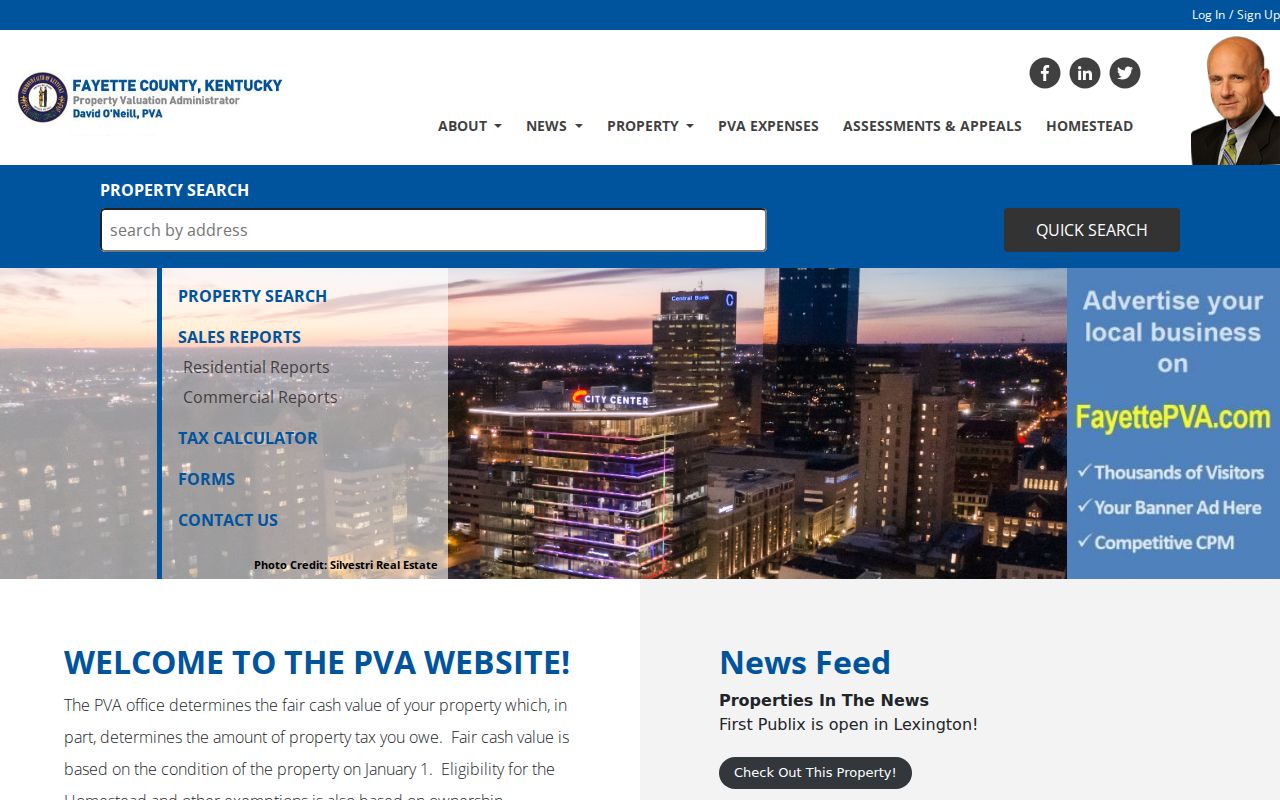
The captured page anchors the search to the public assessment custodian rather than an unverified commercial listing.
- Parcel
- A mapped piece of land with its own tax identifier.
- Situs
- The physical location of the parcel, which may differ from the owner's mailing address.
- Index
- A finding aid that points to a record, not the certified record itself.
- Criss-cross directory
- A volume arranged by street and house number instead of only by surname.
Fayette Deeds Directory Trail
Fayette Deeds searches far beyond a simple surname. The live form accepts a grantor, a grantee, one name across both roles, street number and name, subdivision, lot, block, instrument number, book and page, description, recorded date range, and consideration range. Instrument filters include deeds, mortgages, liens, plats, releases, wills, powers of attorney, and other land records. Results may show parties, record date, instrument, property description, cross-reference, consideration, and an image indicator. The search caps a result at 1,000 rows, so common names need a date, role, or address filter.
| Search control | Best use | Format note |
|---|---|---|
| Grantor or grantee | Follow a transfer | Separate surname, first name, and middle initial |
| Street fields | Tie an instrument to a place | Number, direction, name, and type are separate |
| Book and page | Retrieve a known citation | Use the exact parcel-card locator |
| Recorded dates | Narrow a common name | Beginning and ending dates use MM/DD/YYYY |
The Fayette deed and land-record index appears in this project capture.
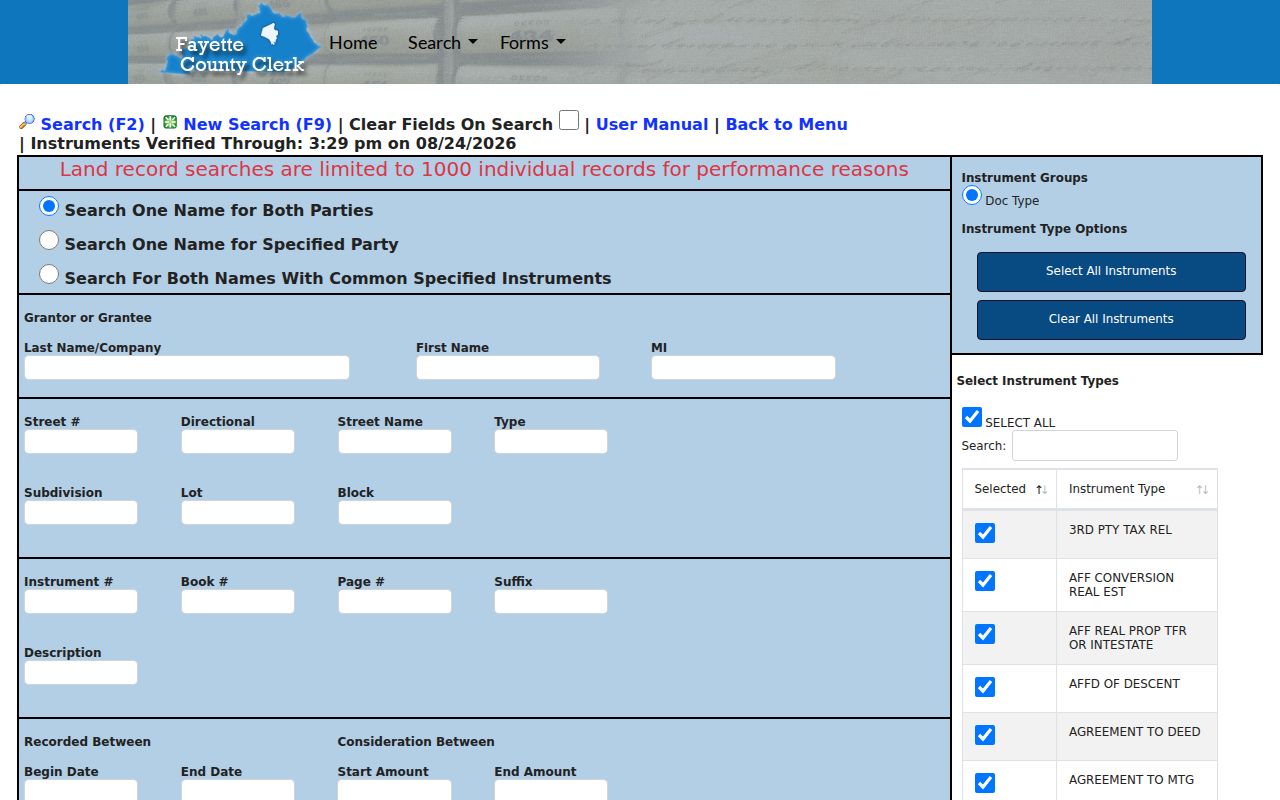
The many filters show why an address, party role, or book and page produces a cleaner search than a bare surname.
Current Fayette County Resident Rolls
Modern Fayette County resident records cover limited groups. The property roll lists owners, not all occupants. The voter tool confirms one registered voter who supplies the required identity fields, not a block roster. Deeds index parties to instruments. CourtNet indexes parties and cases statewide. Community Corrections and state registries cover only the populations defined by those systems. Comparing scope before searching keeps the residents directory accurate.
| Source | Who It Lists | Keeper | Access |
|---|---|---|---|
| PVA property roll | Parcel and tax-date owners | Fayette PVA | Public search and office |
| Voter Information Center | The identity-matched voter | Kentucky State Board of Elections | Name and birth date required |
| Fayette Deeds | Parties to recorded instruments | Fayette County Clerk | Index, counter, and copy request |
| CourtNet | Parties in indexed cases | Kentucky Court of Justice | Index, then clerk for file |
| Neighborhood associations | Registered civic groups, not residents | LFUCG planning | Public association finder |
Use the PVA and deed index for parcel and title questions. Use the identity-gated voter tool for one's own registration. A case index needs a clerk copy before it supports a firm conclusion. Official rolls disclose their custodian and purpose; commercial people-finder results may merge old addresses or same-name people without showing the source.
Fayette Court Resident Records
Kentucky CourtNet covers all 120 counties and supports party, case, citation, and business searches. Its official manual documents Party Type, Case Type, County, last and first name, Starts With, Exact, and Sound Like modes, plus date of birth and event-date filters. Results can include party role, county, case number and type, active status, next event, and case title. Case tabs can lead to parties, charges, documents, events, and images. The current public endpoint redirected to a login during research, so the manual supplies the verified field model.
The Kentucky CourtNet entry point is shown here.
A result is still an index entry. Fayette court clerks hold the files, while older retained cases may move to the State Records Center or KDLA.
Fayette Voter Lookup Boundaries
The Kentucky Voter Information Center requires legal first name, legal last name, and date of birth; the last four Social Security digits are optional. It returns registration status, polling place, and absentee status for the matched voter. It does not expose a public reverse-address list. A full voter-data request uses Form SBE-84, an oath, coverage and format choices, and statutory limits. Fayette County election staff can answer local questions at 859-255-8683.
Lawful use. Public records may support family, property, civic, and personal research, but never stalking, harassment, threats, or harm.
Fayette Resident Vital Records
Vital certificates verify life events but do not work as an open Fayette County residents directory. Kentucky's Office of Vital Statistics supplies statewide birth and death certificates from 1911 forward and central marriage and divorce records from June 1958 forward. Applications require the facts requested on the form, identification, and any eligibility that applies. Under KRS 213.131, birth records remain confidential for 100 years and death records for 50 years, while annual indexes are open only as the statute provides.
Earlier Fayette marriage records belong with the County Clerk, and earlier divorce files belong with the Circuit Clerk. Historical gaps can lead to KDLA, the Kentucky Historical Society, church registers, cemetery sources, newspapers, or the Lexington Public Library. A certificate copy and a court file are different records, so the event date determines which custodian should receive the request.
Lexington Records Center Fallback
Not every Lexington-Fayette record has a public search screen. The LFUCG Records Center and Archives at 1306 Versailles Road keeps city-government series and accepts requests through the city's open-records process. Published hours are Monday through Thursday, 8:00 a.m. to 5:00 p.m., and Friday, 8:00 a.m. to noon. The phone is 859-425-2071. It is the right fallback for a specific permit, administrative file, order, or other city series that does not appear in a department portal. Deeds and court records still go to their own custodians.
The LFUCG Records Center and Archives page is preserved in this capture.
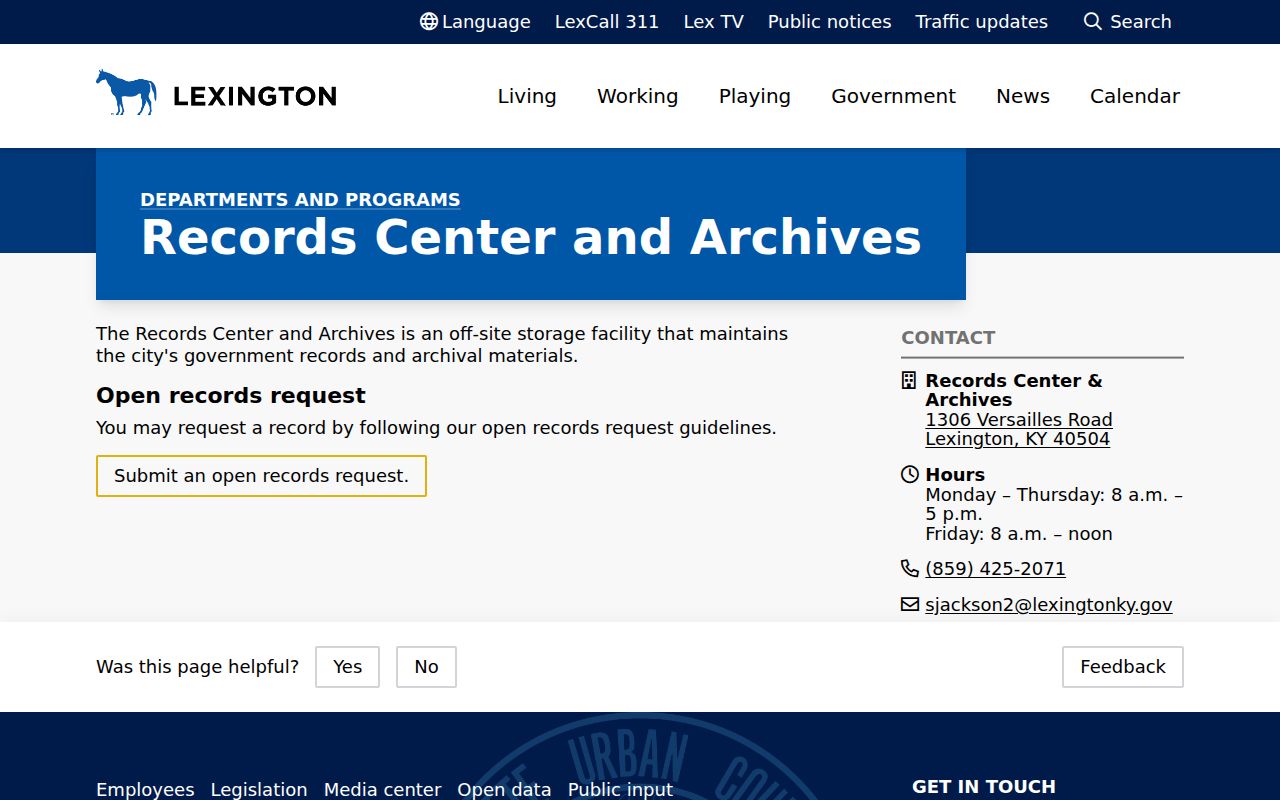
The office page gives the local request route when a search box cannot reveal a city-held record.
Kentucky Open Records Requests
KRS 61.872, 61.874, 61.876, and 61.880 govern access, copies, agency rules, responses, and appeals under the Kentucky Open Records Act. A request should be written and signed, identify the requester, and describe the record with enough detail for staff to locate it. Agencies generally issue a decision within five working days, apart from weekends and holidays. If unusual circumstances delay production, the notice should explain why and give an expected date. A denial must identify and apply the relevant exception.
The Fayette Clerk accepts requests in person, by mail, fax, or scanned email. A book and page, instrument number, recording date, party, or property address improves a land-record request. City, police, court, library, and archive records each use their own custodian route. Certified copies must come from the keeper, not from a residents directory search.
Fayette Custody Directory Scope
Lexington Community Corrections publishes a current-inmate information route for bond and charge details, with help at 859-425-2700. Its live field labels were behind a login during inspection, so no unverified search controls should be assumed. Kentucky Offender Online Lookup covers state custody and supervision, updates daily, and offers name, alias, identifier, location, county, demographic, offense, and supervision filters. Recent entries may not yet be final. These systems describe a defined correctional population, not a general list of Fayette County residents.
The Lexington inmate information page is shown below.
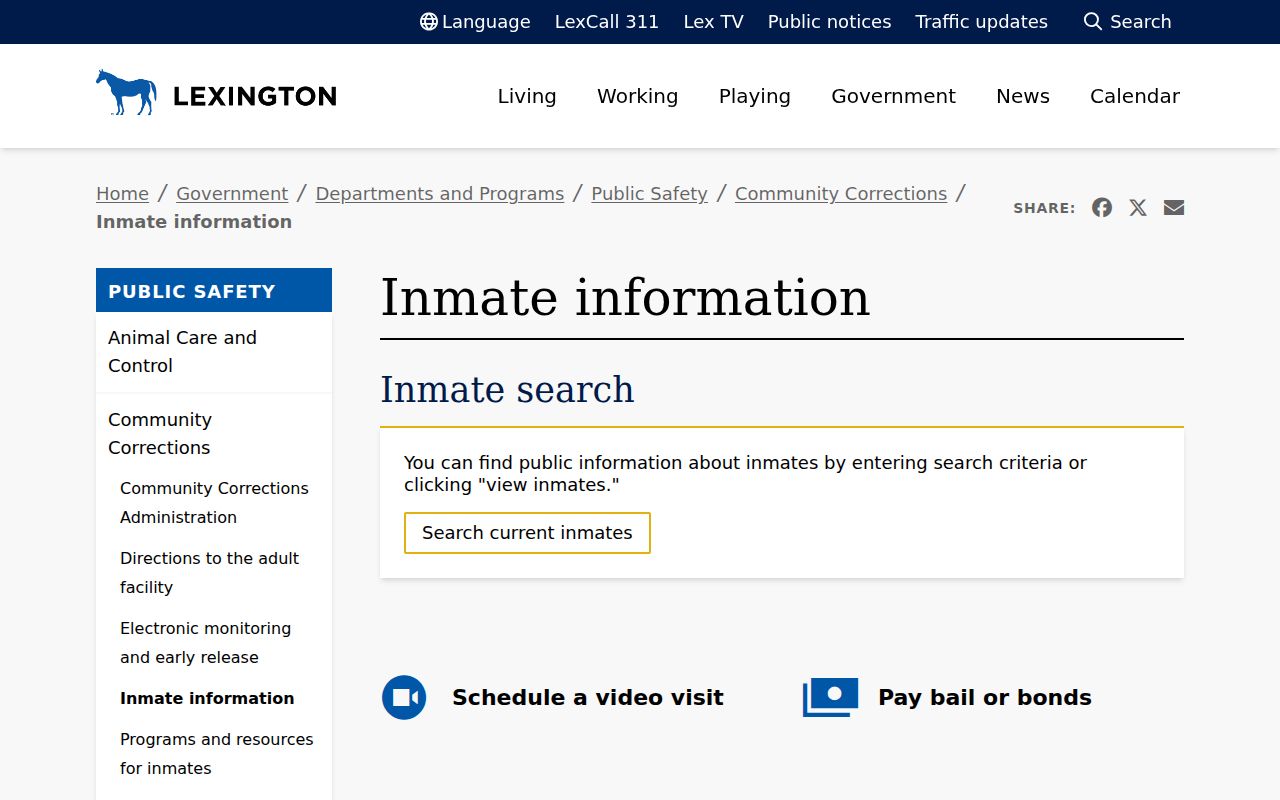
The city source identifies the official local route and phone fallback without turning a custody list into a general people search.
Historic Fayette County Directories
The Lexington Public Library Kentucky Room holds the strongest local shelf for older residents. Its collections include Lexington directories from the nineteenth century, later telephone directories, a 1971 farm directory, newspapers, obituaries, cemetery material, maps, yearbooks, and local files. Digitized directory pages can reveal a surname and given name, spouse, occupation or employer, a home or boarding mark, and a street address. Printed abbreviations and period editorial marks must be read in historical context.
Use several volumes to see when a household first appears, changes address, or vanishes from the run, then pair directory years with census, deed, probate, obituary, and map evidence. The full shelf and entry-reading method belongs to the Fayette County city directory. KDLA and the Kentucky Historical Society offer fallback access to courthouse, probate, naturalization, and vital material that is not online.
Fayette's non-indexed clerk books reach into the late 1700s and include a burnt-records group, wills, court orders, surveys, marriages, guardians, tax books, and separate Black and white school censuses from 1896 through 1910. This local record texture explains why an old residents directory search may move from a modern portal to a book, microfilm reel, or archive request.
A narrow request works best at every historical stop. Give the county, name, exact address, likely year range, and any book, page, case, or directory citation already found. The library offers limited local-history requests for specifically cited items, while KDLA asks for the county, record type, name, date range, and locator. That preparation helps staff distinguish a missing online image from a record that survives only in a non-indexed book.