
Fayette Address Sources by Era
Previous residents surface in overlapping records, not one continuous roll. Begin with the newest reliable parcel and deed, then choose the older source closest to the date in question. The era table distinguishes legal ownership, listed occupancy, household composition, and physical change.
| Source | Years it covers | Where held | What it shows |
|---|---|---|---|
| PVA and deed references | Current assessment and card history | Fayette PVA | Owner, situs, parcel, legal description, sales bridge |
| Recorded deeds and old books | Series reach the late 1700s; live indexed start unstated | Fayette County Clerk | Recorded parties, dates, book/page, land description |
| City and rural directories | Selected digitized runs, 1864-65 through 1971 | LPL Kentucky Room and digital archive | Listed adults, address, spouse, work or affiliation |
| Telephone directories | Selected verified runs, 1933 through 1977 | LPL digital archive and Kentucky Room | Subscriber and address clues |
| Federal census | Public schedules through 1950 under the 72-year rule | Federal and library research access | Household at one enumeration date |
| Sanborn maps | 1886, 1896, 1907, and 1934-1950 editions verified | Library of Congress and UK Maps Library | Building footprint, use, number, and street context |
For a recent transfer, the PVA-to-deed route is fastest. For previous residents who did not own the parcel, move to a directory or census year. When the address itself is uncertain, a plat, legal description, or Sanborn sheet is more useful than a modern mailing label.
Fix the Fayette Parcel First
Capture the exact street number, unit, situs, mailing address, PVANUM, lot, block, subdivision, acreage, and current deed reference from the Fayette PVA property search. A legal description anchors the land even when a street name, unit label, or number changes. Keep the January 1 owner separate from a later buyer.
Then confirm the parcel shape in LFUCG GIS. The map layer provides PVANUM and geometry but no owner name. That split is useful: GIS proves which polygon is under study, while the PVA card supplies the assessment name and deed-book bridge. A rear lot or condo unit can otherwise send the backward trail down the wrong chain.
Trace Fayette Owners Backward
The Fayette deed index supports party, address, book/page, instrument, date, consideration, and legal-description searching. Start with the current purchase deed, not a broad surname result. Confirm that its property description matches the target parcel before following names into an earlier transaction.
- Copy the present owner, deed book/page, and legal description from the PVA card.
- Open that deed in Fayette Deeds and identify the grantor, the party who transferred the interest.
- Search that seller as a grantee, the party who previously received the interest. Match the legal description and dates.
- Repeat the seller-as-buyer step. Note estates, trusts, corporations, correction deeds, and name variants.
- When the live index ends, take the last book/page and exact description to the Clerk's non-indexed books or an archive request.
- Grantor and grantee
- The grantor transfers an interest; the grantee receives it.
- Chain of title
- The linked sequence of recorded transfers for the same land.
- Legal description
- The lot, block, subdivision, plat, or metes-and-bounds wording that identifies land beyond its mailing address.
Deeds prove recorded parties, not residence. Add mortgages and releases only as dated context. A transfer into an estate or trust can change the name path without changing who occupied the place.
Fayette Old Books Extend the Trail
The Clerk's historical instructions identify deed books reaching the late 1700s, an old deed sequence beginning in 1825, wills through 1935, and separate order, guardian, survey, tax, marriage, and school-census groups. These series are not all searchable like the live index. Use the last firm name, date, book reference, land description, or estate connection to frame a narrow request.
The historical and non-indexed instructions are visible in the captured source below.

The image reinforces a key rule for previous residents research: an empty modern query must be followed by the appropriate old book group before declaring a gap.
Courthouse Disasters and Fayette Records
KDLA records Fayette courthouse disasters in 1803 and 1897. The Clerk separately lists a burnt_records group with books dated through the early period. The sources do not prove that a specific deed was lost in either disaster, so the safe conclusion is procedural: search the named group, old deeds, county orders, surveys, wills, and tax books before assuming no evidence survives.
The Kentucky courthouse disaster history is captured below.
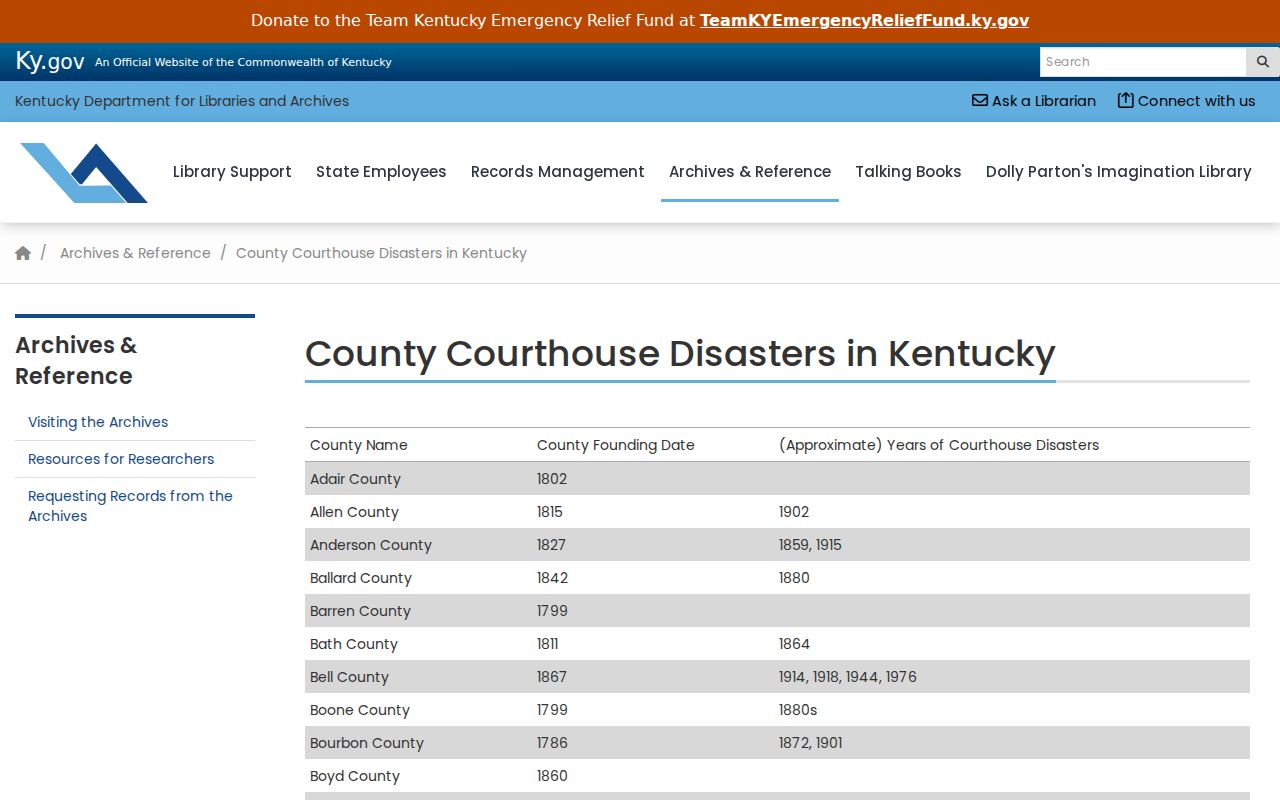
This statewide archival page gives context, while the Fayette Clerk's own series list supplies the local route. A series-specific request to the Clerk or KDLA is stronger than a general name search.
Fayette Previous Residents in Directories
Ownership is only half the address story. Lexington Public Library directories can identify a listed adult, spouse, boarder, subscriber, business, or farm connection. Verified digital runs include 1864-65, 1877-78, 1906-07, the 1912 rural directory, 1923, 1940-41, 1958, telephone volumes through 1977, and the 1971 Fayette County Farm Directory. Missing years must not be treated as missing people.
A 1906-07 entry may use h for home and bds or b for boarding, with a spouse in parentheses and a work or firm reference. Preserve the exact spelling and symbols. The collection details and publishers belong on the Fayette County city directory page; the backward address task uses each volume as one dated layer.
- Search the address section or OCR for the exact printed street form, then copy every listed name and abbreviation.
- Check the closest earlier and later volume. Record changes without assuming that silence equals a move.
- Pair the directory with the nearest public census year. Compare names, ages, relationships, and address geography.
- Use newspaper, obituary, probate, and cemetery sources to explain a death, marriage, estate transfer, or move.
Map Old Lexington House Numbers
Sanborn fire-insurance maps provide building footprints, use, lot context, intersections, and period street numbers. Verified Lexington sets date to 1886, 1896, 1907, and 1934 through October 1950. They do not name residents. Their value is proving that a structure and label existed near the date shown in a directory or deed.
Research did not locate a complete official Lexington renumbering schedule. Bridge an uncertain address with deeds, plats, street sections, census geography, and Sanborn sheets. Keep both the modern and printed forms in the worksheet until the legal description or map context confirms the match.
Note: A modern ZIP code should never be projected backward into an era before ZIP codes without an independent address and map check.
Fayette Permits Date Property Change
LFUCG building permits, One-Stop, AgencyCounter, Code Enforcement, and final orders can date construction, alteration, inspection, nuisance action, or a lien event. They can also name an applicant, owner, or contact. None of those labels alone proves occupancy.
The interactive systems did not expose stable historical cutoffs or complete field lists during research. Search by exact address, then make a narrow city open-records request for a project, order, or date range. The LFUCG Records Center and Archives is the fallback for city series not available through the web portal.
Close Fayette Resident Trails Carefully
An obituary or probate file can explain why a name leaves an address or why an estate appears in the deed chain. The Lexington Public Library Local History Index covers selected newspaper articles from 1787-2007. HeritageHub adds obituary and death-notice research, while Herald-Leader text and digital archives have their own later coverage. These are distinct searches, not one complete obituary index.
The library's genealogy request form works best with a specific citation and allows requests for a limited number of Local History Index articles. KDLA's probate guide, Fayette will books, cemetery maps, and Kentucky vital-record routes can then confirm an estate or death. A cemetery clue is not a death certificate, and an annual vital index is not the certified image.
Limits on Fayette Previous Residents
A backward trail can identify recorded owners and selected listed occupants, but it cannot reconstruct every person who stayed at an address. Directories omit people, census schedules capture one date, and telephone books list subscribers. Restricted vital records, sealed cases, redacted files, and protected Safe at Home physical addresses also set firm boundaries.
Keep a worksheet with source, year, keeper, exact address form, person named, role, and image or citation. Mark claims as owner, resident, boarder, subscriber, applicant, heir, or other party. This prevents one record's narrow label from becoming an unsupported household claim.
Lawful use. Research Fayette County previous residents for house history, family history, estates, and personal curiosity. Never use the trail to track, harass, intimidate, or harm a living person.